The Night Shift Your Heart Works, Even When You Don't
El turno nocturno que trabaja tu corazón, incluso cuando tú no
Your body does its deepest repair after dark. When your nights are broken, something quiet and serious can unfold while you sleep, and for many of us, no one has ever named it.
Tu cuerpo hace su reparación más profunda al caer la noche. Cuando tus noches se rompen, algo silencioso y serio puede desarrollarse mientras duermes, y para muchos de nosotros, nadie le ha puesto nombre.
MP
Marlon Parra, APRN
Cercanos Care Provider
Proveedor de Cercanos Care
·August 11, 202611 de agosto de 2026·7 min read7 min de lectura
A Moment You May Recognize
You did everything right this week. You took your medicine. You watched what you ate. You made it through another long day, the drive, the work, the dinner, the dishes, the conversation that ran well past ten. You fell into bed certain you would finally rest.
Then, somewhere around 2 a.m., your body woke you and never said why. Maybe you lay there a while as that low hum of worry came back, your numbers, your weight, your blood pressure. Then morning arrived anyway: the alarm, the coffee, the heaviness behind your eyes that no amount of sleep seems to lift.
That tiredness, the kind that sits in your chest as much as your body, may be tied to something your doctors don't always ask about. Something happening in the very hours when you think nothing is happening at all.
It has a name. And once something is named, it can be helped.
What Sleep Actually Does
Think of sleep as your body's night crew, the quiet team that repairs everything the day wears down. Your blood vessels depend on that crew. So does your heart. So does your metabolism, the whole system that manages your blood sugar, your blood pressure, and the low-grade inflammation running underneath both. When the night crew can't finish its work, the damage carries into the day.
There are two ways this goes wrong. The first is simple: too few hours, night after night. The second is quieter and far easier to miss: obstructive sleep apnea, or OSA, where the throat relaxes and briefly closes during sleep, so breathing stops and restarts again and again. Your oxygen dips. Your heart surges. Your body spends the night in a quiet emergency you never remember in the morning.
Here is what matters most if you are managing high blood pressure, diabetes, or heart disease: sleep is not separate from those conditions. It is woven right into them.
The exhaustion that no amount of coffee seems to fix can be a signal worth listening to, not a personal failing.
The Signs That Are Easy to Miss
Most people picture sleep apnea as thunderous snoring and an elbow in the ribs. Snoring is the most common red flag, but it is far from the only one, and plenty of people who have OSA don't snore dramatically at all. Watch for these, in yourself or in someone you love:
Loud snoring, or snoring that stops and starts
Gasping or choking, or a partner seeing you stop breathing
Waking with a dry mouth or a morning headache
Waking unrefreshed, no matter how long you slept
Dozing off at the TV, at a red light, after lunch
Trouble focusing, forgetfulness, a shorter fuse
Getting up several times a night to use the bathroom
Low mood, anxiety, or feeling "wired but tired"
Women often show a different face of OSA. Instead of dramatic snoring, they are more likely to report fatigue, trouble sleeping, low mood, or anxiety, one reason women are diagnosed far less often, and far later. If that sounds like you, it is worth saying out loud.
Feeling used to being tired is not the same as being rested.
Who Is Most at Risk
OSA does not strike at random. The single strongest risk factor is carrying extra weight. In the largest U.S. study of Latino adults' sleep, obesity raised the odds of meaningful sleep apnea nearly 17-fold. Other things that lift the risk: being male, growing older, a larger neck size, a family history of apnea, smoking, and drinking alcohol close to bedtime. For women, menopause raises the risk. Chronic nasal congestion and enlarged tonsils play a part too.
For our community, two of the biggest risk factors, obesity and type 2 diabetes, are also two of the most common conditions we manage together at every visit. That overlap is exactly why sleep deserves a seat at the table in your care, not a footnote.
1 in 3
middle-aged men meet criteria for OSA (about 1 in 6 women)
40–80%
OSA prevalence among people with heart disease, heart failure, or AFib
up to 80%
of hard-to-control (resistant) high blood pressure may involve undiagnosed OSA
Closer to home
The numbers for our community. The Hispanic Community Health Study / Study of Latinos is the largest look at sleep in U.S. Latino adults, and one of its four research sites was right here in Miami. What it found is hard to ignore.
~1 in 4
Latino adults show signs of sleep-disordered breathing
~1 in 100
have ever been diagnosed with sleep apnea
8 in 10+
of Latinos who have OSA go untreated
Read that again. Most of the people carrying this are carrying it without a name for it. Roughly a third of Latino men and about one in six Latino women meet criteria for OSA, and the same research ties it directly to higher rates of diabetes, high blood sugar, and high blood pressure.
Source: Hispanic Community Health Study / Study of Latinos (HCHS/SOL).
What It Costs When It Goes Unaddressed
Every time breathing pauses, oxygen drops and the body reacts as if it is under threat: a jolt of stress hormones, a spike in blood pressure, the nervous system on high alert. Then it happens again. Sometimes dozens of times an hour, all night long. Over years, that pattern leaves a mark.
Untreated OSA is linked to blood pressure that won't come down even on several medicines, worsening blood sugar and type 2 diabetes, an irregular heartbeat called atrial fibrillation, heart failure, coronary artery disease, and stroke. Newer research even connects it to changes in memory and brain health as we age.
There is also growing attention on something called hypoxic burden, not just how often breathing pauses, but how deep and how long each oxygen drop goes. A 2025 study found this measure of nighttime oxygen stress predicted major heart events better than the old-fashioned count of pauses alone.
Managing a chronic condition is already exhausting. Adding a hidden sleep problem on top of it creates a fatigue that feels personal, like a failure of willpower. It isn't. It is physiology. And physiology can be treated.
"Your blood pressure pills may be doing everything right. But if your body spends the night in a quiet emergency, the numbers will show it."
Marlon Parra, APRN
How Sleep Apnea Is Actually Found
Here is the reassuring part: finding out is simpler than most people expect. Catching OSA early, before years of strain add up, is one of the highest-value things we can do for your heart and your blood sugar. It usually goes like this:
A short conversation and a quick screen.
A brief questionnaire, often one called STOP-BANG, lets your provider gauge your risk in minutes, even if you sleep alone.
A home sleep test, in many cases.
A small device you wear for one night in your own bed. No hospital, no tangle of wires.
An in-lab study, when needed.
For a fuller picture, an overnight sleep study can measure exactly what is happening while you rest.
A Realistic Path Forward
Sleep apnea, once it is found, is treatable, and treating it changes real numbers in real bodies. Evidence shows it can lower blood pressure, improve blood sugar control, steady the heart, and lift the fog you have been pushing through for years. Not overnight, but over weeks and months of steady, patient care.
Your body is not working against you. Night after night, it has been sending signals and waiting for someone to listen. You just took the first step, recognition. That is not a small thing. It is where nearly every good outcome begins.
The Treatment
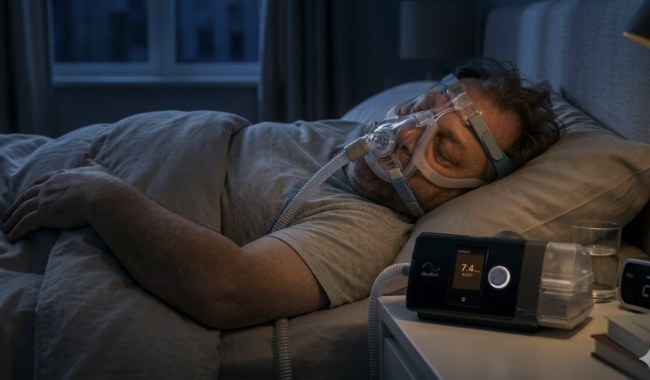
For moderate or severe apnea, a CPAP mask gently keeps the airway open, so the body finally gets the deep, unbroken sleep it has been missing.
The Difference It Makes
Weeks of steady sleep, and even modest weight loss, tend to show up where it matters most: clearer mornings, steadier energy, and feeling like yourself again.
Small Steps That Actually Work
Ask the one question you haven't asked.
At your next visit, say: "I've been tired even after I sleep. Could we check whether I should be evaluated for sleep apnea?" That single sentence can change your whole treatment picture.
Ask the people who share your nights.
A partner, an adult child, whoever is nearby: "Have you ever heard me snore loudly, gasp, or stop breathing?" The people who love you often notice first. This is one conversation worth having at the table.
Protect your sleep, pick just one thing.
A cooler, darker room. A bedtime thirty minutes earlier. Try one change for a week and notice what shifts. You don't have to fix everything at once.
Put the phone down 30 minutes before bed.
Give your nervous system room to downshift before sleep. The notifications will still be there in the morning.
Know what that nightcap is really doing.
Alcohol feels relaxing, but in the second half of the night it fragments your sleep and loosens the throat muscles in ways that make apnea worse. This isn't about guilt, it's about knowing.
Bring sleep into every heart and sugar conversation.
Every talk about your blood pressure, your A1C, or your weight is also a talk about your sleep. It belongs there. Raising it is not a distraction, it is part of the plan.
Somewhere in the long list of things you are already managing, the medicines, the appointments, the food, the worry, sleep may be the one you have been given the least permission to put first. Let this be that permission.
A Closing Thought
The people who walk this road with you, your care team, and the ones at home who notice when you seem more tired than usual, want to know what is happening in those dark hours too. You do not have to carry it alone, and you do not have to have it all figured out tonight.
Whatever your next step looks like, however small, it already counts.
This article is for educational purposes only and does not replace clinical consultation. Always discuss your health with your care team.
How Cercanos helps
At Cercanos, sleep is part of the conversation, not an afterthought. Our care team can screen your risk in minutes, arrange a simple at-home sleep test when it makes sense, and help you act on what we find, alongside the blood pressure, blood sugar, and heart care you are already getting. You do not have to do this alone.
Redline S, Sotres-Alvarez D, Loredo J, et al. Sleep-Disordered Breathing in Hispanic/Latino Individuals of Diverse Backgrounds: The Hispanic Community Health Study / Study of Latinos (HCHS/SOL). Am J Respir Crit Care Med. 2014;189(3):335–344.
Yeghiazarians Y, Jneid H, Tietjens JR, et al. Obstructive Sleep Apnea and Cardiovascular Disease: A Scientific Statement From the American Heart Association. Circulation. 2021;144:e56–e67.
Peker Y, et al. Association of Hypoxic Burden With Cardiovascular Events: A Risk Stratification Analysis of the RICCADSA Cohort. CHEST. 2025;168(6):1481–1493.
Additional HCHS/SOL analyses of sleep apnea prevalence, hypertension control, and treatment gaps in U.S. Hispanic/Latino adults (2014–2024).
Un momento que quizá reconozcas
Esta semana hiciste todo bien. Tomaste tu medicina. Cuidaste lo que comiste. Sobreviviste a otro día largo, el trayecto, el trabajo, la cena, los platos, la conversación que se alargó más allá de las diez. Te dejaste caer en la cama seguro de que por fin descansarías.
Entonces, cerca de las 2 de la mañana, tu cuerpo te despertó y nunca dijo por qué. Tal vez te quedaste ahí un rato mientras volvía ese murmullo bajo de preocupación, tus números, tu peso, tu presión arterial. Y aun así llegó la mañana: la alarma, el café, esa pesadez detrás de los ojos que ninguna cantidad de sueño parece levantar.
Ese cansancio, del tipo que se asienta tanto en el pecho como en el cuerpo, puede estar ligado a algo que tus médicos no siempre preguntan. Algo que ocurre justo en las horas en que crees que no ocurre nada.
Tiene un nombre. Y una vez que algo tiene nombre, se puede ayudar.
Lo que el sueño realmente hace
Piensa en el sueño como el turno nocturno de tu cuerpo, el equipo silencioso que repara todo lo que el día desgasta. Tus vasos sanguíneos dependen de ese equipo. También tu corazón. También tu metabolismo, todo el sistema que maneja tu azúcar en la sangre, tu presión arterial y la inflamación de bajo grado que corre por debajo de ambos. Cuando el turno nocturno no puede terminar su trabajo, el daño se traslada al día.
Hay dos formas en que esto sale mal. La primera es simple: muy pocas horas, noche tras noche. La segunda es más silenciosa y mucho más fácil de pasar por alto: la apnea obstructiva del sueño, o AOS, en la que la garganta se relaja y se cierra brevemente durante el sueño, de modo que la respiración se detiene y se reinicia una y otra vez. Tu oxígeno baja. Tu corazón se acelera. Tu cuerpo pasa la noche en una emergencia silenciosa que nunca recuerdas por la mañana.
Esto es lo que más importa si estás manejando presión arterial alta, diabetes o enfermedad del corazón: el sueño no está separado de esas condiciones. Está entretejido en ellas.
El agotamiento que ninguna cantidad de café parece resolver puede ser una señal que vale la pena escuchar, no una falla personal.
Las señales que son fáciles de pasar por alto
La mayoría imagina la apnea del sueño como ronquidos atronadores y un codazo en las costillas. El ronquido es la señal de alarma más común, pero está lejos de ser la única, y muchas personas con AOS no roncan de forma dramática en absoluto. Presta atención a estas señales, en ti o en alguien que amas:
Ronquidos fuertes, o ronquidos que se detienen y arrancan
Jadeos o ahogos, o que tu pareja te vea dejar de respirar
Despertar con la boca seca o con dolor de cabeza por la mañana
Despertar sin sentirte descansado, sin importar cuánto dormiste
Quedarte dormido frente al televisor, en un semáforo, después de almorzar
Dificultad para concentrarte, olvidos, menos paciencia
Levantarte varias veces en la noche para ir al baño
Ánimo bajo, ansiedad, o sentirte "acelerado pero agotado"
Las mujeres a menudo muestran una cara distinta de la AOS. En lugar de ronquidos dramáticos, es más probable que reporten fatiga, problemas para dormir, ánimo bajo o ansiedad, una razón por la que las mujeres se diagnostican mucho menos, y mucho más tarde. Si esto se parece a lo que vives, vale la pena decirlo en voz alta.
Acostumbrarse a estar cansado no es lo mismo que estar descansado.
Quiénes tienen mayor riesgo
La AOS no aparece al azar. El factor de riesgo más fuerte es cargar peso de más. En el estudio más grande de EE. UU. sobre el sueño en adultos latinos, la obesidad aumentó las probabilidades de una apnea del sueño significativa casi 17 veces. Otras cosas que elevan el riesgo: ser hombre, tener más edad, un cuello más ancho, antecedentes familiares de apnea, fumar y beber alcohol cerca de la hora de dormir. En las mujeres, la menopausia aumenta el riesgo. La congestión nasal crónica y las amígdalas agrandadas también influyen.
Para nuestra comunidad, dos de los mayores factores de riesgo, la obesidad y la diabetes tipo 2, son también dos de las condiciones más comunes que manejamos juntos en cada visita. Ese cruce es exactamente por qué el sueño merece un lugar en la mesa de tu cuidado, no una nota al pie.
1 de 3
hombres de mediana edad cumple criterios de AOS (cerca de 1 de 6 mujeres)
40–80%
prevalencia de AOS entre personas con enfermedad del corazón, insuficiencia cardíaca o fibrilación auricular
hasta 80%
de la presión alta difícil de controlar (resistente) puede involucrar AOS sin diagnosticar
Más cerca de casa
Los números para nuestra comunidad. El Estudio de Salud Comunitaria Hispana / Estudio de Latinos es la mirada más grande al sueño en adultos latinos de EE. UU., y uno de sus cuatro centros de investigación estuvo aquí mismo, en Miami. Lo que encontró es difícil de ignorar.
~1 de 4
adultos latinos muestra señales de respiración alterada durante el sueño
~1 de 100
ha sido diagnosticado alguna vez con apnea del sueño
8 de 10+
de los latinos que tienen AOS no reciben tratamiento
Léelo otra vez. La mayoría de las personas que cargan esto lo cargan sin un nombre para ello. Cerca de un tercio de los hombres latinos y una de cada seis mujeres latinas cumple criterios de AOS, y la misma investigación lo relaciona directamente con tasas más altas de diabetes, azúcar alta y presión arterial alta.
Fuente: Estudio de Salud Comunitaria Hispana / Estudio de Latinos (HCHS/SOL).
Lo que cuesta cuando no se atiende
Cada vez que la respiración se detiene, el oxígeno cae y el cuerpo reacciona como si estuviera bajo amenaza: una descarga de hormonas del estrés, un pico en la presión arterial, el sistema nervioso en alerta máxima. Y luego vuelve a pasar. A veces docenas de veces por hora, toda la noche. Con los años, ese patrón deja huella.
La AOS sin tratar se relaciona con presión arterial que no baja ni con varios medicamentos, con azúcar en la sangre y diabetes tipo 2 que empeoran, con un ritmo cardíaco irregular llamado fibrilación auricular, con insuficiencia cardíaca, enfermedad de las arterias coronarias y derrame cerebral. Investigaciones más recientes incluso la conectan con cambios en la memoria y la salud del cerebro a medida que envejecemos.
También hay creciente atención en algo llamado carga hipóxica, no solo cuántas veces se detiene la respiración, sino qué tan profunda y qué tan larga es cada caída de oxígeno. Un estudio de 2025 encontró que esta medida del estrés de oxígeno nocturno predijo eventos cardíacos mayores mejor que el antiguo conteo de pausas por sí solo.
Manejar una condición crónica ya es agotador. Sumarle un problema de sueño oculto crea un cansancio que se siente personal, como una falta de fuerza de voluntad. No lo es. Es fisiología. Y la fisiología se puede tratar.
"Tus pastillas para la presión pueden estar haciendo todo bien. Pero si tu cuerpo pasa la noche en una emergencia silenciosa, los números lo van a mostrar."
Marlon Parra, APRN
Cómo se encuentra realmente la apnea del sueño
Esta es la parte tranquilizadora: descubrirlo es más sencillo de lo que la mayoría espera. Detectar la AOS temprano, antes de que se acumulen años de desgaste, es una de las cosas de mayor valor que podemos hacer por tu corazón y tu azúcar en la sangre. Por lo general ocurre así:
Una conversación breve y una evaluación rápida.
Un cuestionario corto, a menudo uno llamado STOP-BANG, permite a tu proveedor calcular tu riesgo en minutos, incluso si duermes solo.
Una prueba de sueño en casa, en muchos casos.
Un pequeño dispositivo que usas por una noche en tu propia cama. Sin hospital, sin una maraña de cables.
Un estudio en laboratorio, cuando se necesita.
Para un panorama más completo, un estudio de sueño de una noche puede medir exactamente qué está pasando mientras descansas.
Un camino realista hacia adelante
La apnea del sueño, una vez que se encuentra, tiene tratamiento, y tratarla cambia números reales en cuerpos reales. La evidencia muestra que puede bajar la presión arterial, mejorar el control del azúcar, estabilizar el corazón y levantar la neblina que has estado atravesando durante años. No de la noche a la mañana, sino a lo largo de semanas y meses de cuidado constante y paciente.
Tu cuerpo no está trabajando en tu contra. Noche tras noche, ha estado enviando señales y esperando a que alguien las escuche. Acabas de dar el primer paso, reconocerlo. Eso no es poca cosa. Es donde comienza casi todo buen resultado.
El tratamiento
Para la apnea moderada o severa, una mascarilla CPAP mantiene la vía aérea abierta con suavidad, para que el cuerpo por fin reciba el sueño profundo e ininterrumpido que le ha faltado.
La diferencia que hace
Semanas de sueño constante, y hasta una pérdida modesta de peso, suelen notarse donde más importa: mañanas más claras, energía más estable y volver a sentirte tú mismo.
Pasos pequeños que de verdad funcionan
Haz la pregunta que aún no has hecho.
En tu próxima visita, di: "He estado cansado incluso después de dormir. ¿Podríamos revisar si debería evaluarme por apnea del sueño?" Esa sola frase puede cambiar todo tu panorama de tratamiento.
Pregúntales a quienes comparten tus noches.
Una pareja, un hijo adulto, quien esté cerca: "¿Alguna vez me has oído roncar fuerte, jadear o dejar de respirar?" Las personas que te aman muchas veces lo notan primero. Es una conversación que vale la pena tener en la mesa.
Protege tu sueño, elige solo una cosa.
Un cuarto más fresco y oscuro. Acostarte treinta minutos antes. Prueba un cambio por una semana y observa qué se mueve. No tienes que arreglarlo todo de una vez.
Deja el teléfono 30 minutos antes de dormir.
Dale a tu sistema nervioso espacio para bajar el ritmo antes del sueño. Las notificaciones seguirán ahí por la mañana.
Ten claro qué está haciendo esa copa antes de dormir.
El alcohol se siente relajante, pero en la segunda mitad de la noche fragmenta tu sueño y relaja los músculos de la garganta de maneras que empeoran la apnea. Esto no es sobre culpa, es sobre saberlo.
Lleva el sueño a cada conversación sobre el corazón y el azúcar.
Cada plática sobre tu presión, tu A1C o tu peso es también una plática sobre tu sueño. Ahí pertenece. Mencionarlo no es una distracción, es parte del plan.
En algún lugar de la larga lista de cosas que ya estás manejando, las medicinas, las citas, la comida, la preocupación, el sueño puede ser lo que menos permiso te han dado para poner primero. Que esto sea ese permiso.
Una reflexión final
Las personas que caminan este camino contigo, tu equipo de cuidado, y quienes están en casa y notan cuando te ves más cansado de lo normal, también quieren saber qué está pasando en esas horas oscuras. No tienes que cargarlo solo, y no tienes que tenerlo todo resuelto esta noche.
Sea cual sea tu próximo paso, por pequeño que sea, ya cuenta.
Este artículo tiene fines educativos únicamente y no reemplaza la consulta clínica. Habla siempre de tu salud con tu equipo de cuidado.
Cómo ayuda Cercanos
En Cercanos, el sueño es parte de la conversación, no algo secundario. Nuestro equipo de cuidado puede evaluar tu riesgo en minutos, coordinar una prueba de sueño sencilla en casa cuando tiene sentido, y ayudarte a actuar sobre lo que encontramos, junto con el cuidado de la presión, el azúcar y el corazón que ya estás recibiendo. No tienes que hacer esto solo.
Redline S, Sotres-Alvarez D, Loredo J, et al. Sleep-Disordered Breathing in Hispanic/Latino Individuals of Diverse Backgrounds: The Hispanic Community Health Study / Study of Latinos (HCHS/SOL). Am J Respir Crit Care Med. 2014;189(3):335–344.
Yeghiazarians Y, Jneid H, Tietjens JR, et al. Obstructive Sleep Apnea and Cardiovascular Disease: A Scientific Statement From the American Heart Association. Circulation. 2021;144:e56–e67.
Peker Y, et al. Association of Hypoxic Burden With Cardiovascular Events: A Risk Stratification Analysis of the RICCADSA Cohort. CHEST. 2025;168(6):1481–1493.
Análisis adicionales del HCHS/SOL sobre la prevalencia de la apnea del sueño, el control de la hipertensión y las brechas de tratamiento en adultos hispanos/latinos de EE. UU. (2014–2024).
Frequently Asked Questions
Preguntas Frecuentes
How do I know if I have sleep apnea if I sleep alone?¿Cómo sé si tengo apnea del sueño si duermo solo?
There are clues you can notice on your own: waking with a dry mouth or headache, feeling genuinely unrefreshed no matter how many hours you slept, or nodding off during the day. A short questionnaire called STOP-BANG can help your care team estimate your risk without a bed partner's input. Bring it up at your next visit, and they can guide you through the next steps, which often begin with a simple test you do at home.
Hay pistas que puedes notar por tu cuenta: despertar con la boca seca o con dolor de cabeza, sentirte de verdad sin descansar sin importar cuántas horas dormiste, o quedarte dormido durante el día. Un cuestionario corto llamado STOP-BANG puede ayudar a tu equipo de cuidado a calcular tu riesgo sin necesidad de alguien que te vea dormir. Menciónalo en tu próxima visita, y ellos pueden guiarte en los siguientes pasos, que a menudo empiezan con una prueba sencilla que haces en casa.
My doctor hasn't mentioned sleep apnea, but I have high blood pressure. Should I bring it up?Mi doctor no ha mencionado la apnea del sueño, pero tengo presión alta. ¿Debería sacar el tema?
Yes, and it is completely reasonable to raise. Research shows that a large share of people with hard-to-control high blood pressure have undiagnosed sleep apnea, yet sleep is still not screened routinely in primary care. Saying, "I read that sleep apnea can affect blood pressure, should we look into it?" is simply being an active partner in your own care. Your team can help decide whether a sleep test makes sense for you.
Sí, y es completamente razonable plantearlo. La investigación muestra que una gran parte de las personas con presión alta difícil de controlar tienen apnea del sueño sin diagnosticar, y aun así el sueño todavía no se evalúa de forma rutinaria en la atención primaria. Decir "leí que la apnea del sueño puede afectar la presión, ¿deberíamos revisarlo?" es simplemente ser un socio activo en tu propio cuidado. Tu equipo puede ayudar a decidir si una prueba de sueño tiene sentido para ti.
I've been told I snore, but I feel fine. Do I really need to worry?Me han dicho que ronco, pero me siento bien. ¿De verdad debo preocuparme?
Snoring alone does not confirm sleep apnea, but it is the most common warning sign. Many people with OSA feel used to their tiredness and no longer recognize it as unusual. Ask yourself honestly: do you feel truly restored after sleep, not just functional, but restored? If the honest answer is no, it is worth a conversation with your provider.
El ronquido por sí solo no confirma la apnea del sueño, pero es la señal de alarma más común. Muchas personas con AOS se acostumbran a su cansancio y ya no lo reconocen como algo fuera de lo normal. Pregúntate con honestidad: ¿te sientes de verdad restaurado después de dormir, no solo funcional, sino restaurado? Si la respuesta honesta es no, vale la pena una conversación con tu proveedor.
If sleep apnea is diagnosed, will I have to sleep with a machine forever?Si me diagnostican apnea del sueño, ¿tendré que dormir con una máquina para siempre?
Not necessarily. For mild cases, changes like weight management, adjusting your sleep position, and reducing alcohol can make a real difference. For moderate or severe OSA, CPAP therapy has the strongest evidence behind it, but comfortable oral appliances work well for many people too. Your care team will work with you to find what actually fits your life, not just what looks best on paper.
No necesariamente. Para casos leves, cambios como el manejo del peso, ajustar la posición al dormir y reducir el alcohol pueden hacer una diferencia real. Para la AOS moderada o severa, la terapia CPAP tiene la evidencia más fuerte, pero los aparatos orales cómodos también funcionan bien para muchas personas. Tu equipo de cuidado trabajará contigo para encontrar lo que de verdad se ajusta a tu vida, no solo lo que se ve mejor en el papel.
Can improving my sleep really change my blood sugar or blood pressure numbers?¿De verdad mejorar mi sueño puede cambiar mis números de azúcar o de presión?
The evidence consistently says it can. Better sleep quality calms the hormonal stress response that pushes blood pressure up, and restoring normal sleep improves how your body handles insulin over time. Across weeks and months, treating sleep as part of your cardiometabolic plan has real, measurable effects. That is not motivational language. That is biology.
La evidencia dice de forma consistente que sí. Una mejor calidad de sueño calma la respuesta hormonal de estrés que sube la presión, y restaurar el sueño normal mejora cómo tu cuerpo maneja la insulina con el tiempo. A lo largo de semanas y meses, tratar el sueño como parte de tu plan cardiometabólico tiene efectos reales y medibles. Eso no es lenguaje motivacional. Es biología.
What's the difference between just being tired and having a sleep disorder?¿Cuál es la diferencia entre solo estar cansado y tener un trastorno del sueño?
Normal tiredness lifts after a good night's sleep. A sleep disorder is when the tiredness stays no matter how long you spend in bed. You wake unrefreshed, struggle to stay alert, and never feel fully recharged. Morning headaches, trouble concentrating, and mood changes can come with it. If that describes most of your mornings, a conversation with your care team is a reasonable next step.
El cansancio normal se levanta después de una buena noche de sueño. Un trastorno del sueño es cuando el cansancio se queda sin importar cuánto tiempo pases en la cama. Despiertas sin descansar, te cuesta mantenerte alerta y nunca te sientes del todo recargado. Los dolores de cabeza matutinos, la dificultad para concentrarte y los cambios de ánimo pueden acompañarlo. Si eso describe la mayoría de tus mañanas, una conversación con tu equipo de cuidado es un siguiente paso razonable.
MP
Marlon Parra, APRN
Advanced Practice Registered Nurse, Cercanos Care
Enfermero de Práctica Avanzada, Cercanos Care
Marlon is an Advanced Practice Registered Nurse on the Cercanos care team, working alongside patients who manage high blood pressure, diabetes, and heart disease. His focus is helping people see the connections between the things they cannot feel, like their sleep, and the numbers that shape their long-term health.
Marlon es Enfermero de Práctica Avanzada del equipo de cuidado de Cercanos, y trabaja junto a pacientes que manejan presión alta, diabetes y enfermedad del corazón. Su enfoque es ayudar a las personas a ver las conexiones entre lo que no pueden sentir, como su sueño, y los números que dan forma a su salud a largo plazo.
Published: August 11, 2026 · Written by Marlon Parra, APRN · Medically reviewed by Juan D. Estrada, MD · Educational content only, not a substitute for individual medical advice.Publicado: 11 de agosto de 2026 · Escrito por Marlon Parra, APRN · Revisado médicamente por Juan D. Estrada, MD · Contenido educativo, no sustituye el consejo médico individual.