Using Your Glucometer at Home: A Step-by-Step Guide
Usando tu glucómetro en casa: Guía paso a paso
How to check your blood sugar correctly, what your numbers mean, and when to call for help.
Cómo medir tu azúcar correctamente, qué significan tus números y cuándo pedir ayuda.
JE
Juan D. Estrada, MD
Co-Founder & CMO, Cercanos Care
Cofundador y CMO, Cercanos Care
·May 11, 202611 de mayo de 2026·6 min read6 min de lectura
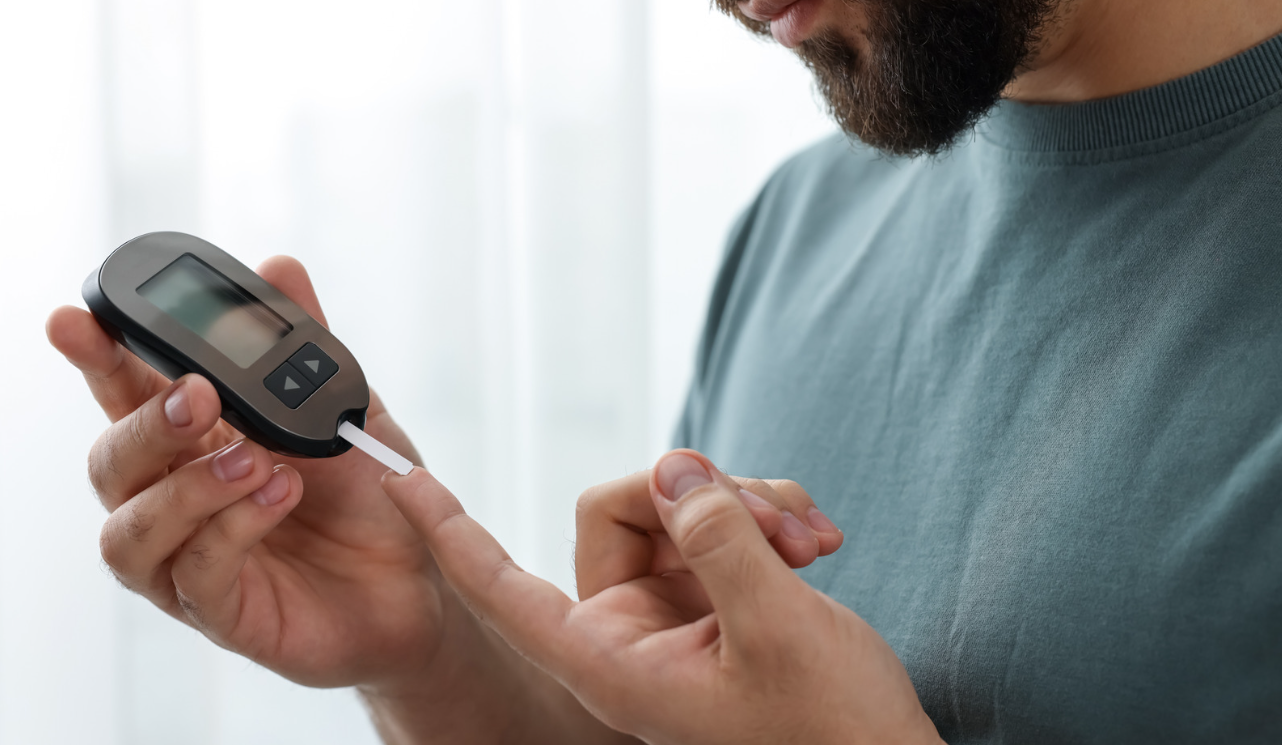
If you have diabetes, your doctor probably handed you a glucometer and told you to check your blood sugar at home. Maybe they said "check it in the morning," or "check it after meals." That is where most of my patients get stuck. The fingerstick hurts when you do it wrong. The numbers do not always make sense. And nobody really sat with you long enough to walk you through it. I have done that walk-through hundreds of times in my office. This article is the same conversation, written down. Let us go through it together.
Why checking your blood sugar at home matters
Your A1C, the lab test you do every three to six months, tells me your average sugar over time. That is useful, but it is also slow. It does not tell me what your sugar does after breakfast, before bed, or on a stressful day. Your glucometer does. The fingerstick reading is a snapshot. When you put a few snapshots together, week after week, you and I can finally see the pattern.
That pattern is what helps us decide if the medication is working, if a meal is spiking your sugar, or if your body needs something different. Without home readings, we are guessing. With them, we are caring for you with real information.
What you need
Five things, no more:
A glucometer. Most insurance plans cover one. Some plans only cover specific brands, so check before you buy.
Test strips that match your glucometer. This is important. Strips from a different brand will not work, and expired strips can give a wrong reading. Always check the expiration date on the bottle.
Lancets. These are the small needles that go in the lancing device to prick your finger. Use a new one every time.
A lancing device. It usually comes with the glucometer.
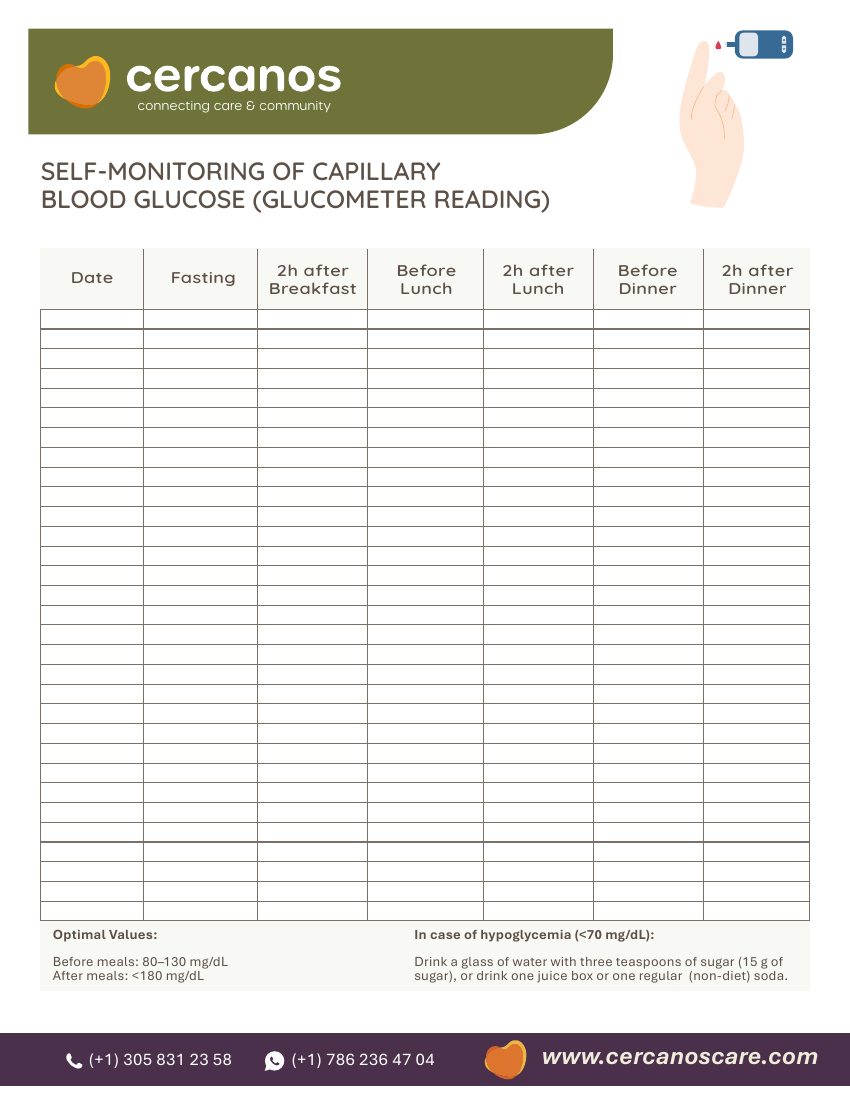
A way to record your numbers. A notebook works. The Cercanos blood sugar log works. Even a notes app on your phone works. The point is that you write the number down, with the date and time, and what you ate or did before.
How to take a glucose reading: 7 steps
This is the part that most patients learn from a quick demo and then forget. The technique matters as much as the device. A small mistake here can give you a number that is 20 or 30 points off. Take it slow the first few times. It will become routine quickly.
Get your supplies ready.
Place your glucometer, a test strip, a lancet (already loaded in the lancing device), and a clean tissue or cotton ball on a flat surface. Check the expiration date on the strip bottle. Open the bottle only to take out one strip, then close it right away. Light and air can damage the strips.
Wash your hands with warm water and soap.
Warm water helps the blood flow to your fingertips. Dry your hands completely. Skip the alcohol wipe. Alcohol can change the reading and dries the skin out over time. If soap and water are not available, use an alcohol pad and let it dry fully before pricking.
Insert the test strip into the glucometer.
Most meters turn on automatically when the strip goes in. Wait for the screen to tell you it is ready for the blood drop.
Prick the side of your fingertip, not the pad.
The side of the fingertip has fewer nerve endings, so it hurts less and heals faster. Rotate fingers each time you check, so the same spot does not get sore. Squeeze your finger gently from the base toward the tip if you need to bring the drop out. Do not squeeze hard, that can mix the blood with tissue fluid and change the reading.
Apply the drop of blood to the test strip.
Touch the edge of the strip to the drop. The strip will pull the blood in by itself. Do not smear the blood on top of the strip. Most meters need only a tiny drop. If the meter shows an error, you may not have used enough blood. Use a fresh strip and try again.
Wait for the result.
Most meters show the number in about 5 seconds. While you wait, press the cotton ball or tissue against the fingertip to stop the bleeding.
Record the result, then dispose of the strip and lancet safely.
Write down the number, the date, the time, and a quick note about what you ate or did. The note is what makes the reading useful later. Throw the used strip in the trash. Throw the used lancet in a hard plastic container with a lid (an empty laundry detergent bottle works) so nobody gets stuck by it. Never reuse a lancet.
When to check your blood sugar
The right schedule depends on your treatment. Your doctor decides this with you. Here are the most common patterns we use with our patients:
If you take insulin: check before each meal, before bed, and any time you feel low (shaky, sweaty, dizzy, confused).
If you take pills only: check fasting in the morning, and a couple of times after meals during the week. This helps us see whether breakfast, lunch, or dinner is the one driving your sugar up.
If you are newly diagnosed or just changed medications: check more often for the first few weeks, so we can see how your body responds.
Always check if you feel symptoms of high or low blood sugar, no matter what the schedule says.
Understanding your numbers
Two numbers matter most: your fasting reading (in the morning, before eating) and your reading two hours after a meal. These are the most common targets your doctor will use. Your personal target may be a little higher or a little lower depending on your age, other health conditions, and risk of low blood sugar. Talk with your Cercanos Provider about the right range for you.
Tracking is what makes the readings useful
A single high or low reading is noise. The pattern is what we treat. When you write the readings down with a quick note ("after rice and beans," "woke up after a stressful night," "forgot the medicine yesterday"), you are giving your doctor or your care coach the full picture. We can adjust the medication, change the timing, or focus on the meal that is causing the spike. Without notes, we are reading numbers in the dark.
Cercanos Patient MaterialMaterial para Pacientes Cercanos
This is the type of material you would receive when you are part of our Cercanos program. You can request to receive it through WhatsApp, or by email, whichever is easier for you.
Este es el tipo de material que recibirías como parte de nuestro programa Cercanos. Lo puedes pedir por WhatsApp o por correo electrónico, lo que te resulte más fácil.
When to call us
Most readings are not emergencies. But these are:
Call your Cercanos Care Coach within a day if:
Your fasting readings are consistently above 180 mg/dL for several days, or your post-meal readings are consistently above 250 mg/dL, even without other symptoms. Patterns matter, even when you feel fine.
Treat low blood sugar at home if:
Your reading is between 54 and 70 mg/dL and you feel shaky, sweaty, dizzy, or confused. Eat or drink 15 grams of fast sugar (4 ounces of juice, 3 to 4 glucose tablets, or a tablespoon of honey). Wait 15 minutes. Re-check. If still low, repeat. If you cannot bring it back up, contact your Cercanos Care Coach.
Call 911 immediately if:
You have a reading above 400 mg/dL with symptoms like confusion, vomiting, deep or fast breathing, fruity-smelling breath, or extreme thirst. These can be signs of a dangerous condition called diabetic ketoacidosis (DKA). Do not wait it out.
Call 911 immediately if:
Your reading is below 54 mg/dL, or if someone with diabetes is unresponsive, having a seizure, or cannot safely swallow. Do not try to give food or water to someone who is unconscious.
The most common mistakes we see
Using alcohol on the finger before pricking. It dries out the skin and can change the reading. Soap and water is enough.
Squeezing the finger too hard. This mixes blood with tissue fluid. Squeeze gently from the base of the finger if needed.
Reusing a lancet. Lancets are designed for one use. After one stick they get dull, and that hurts more and increases the risk of infection.
Using expired strips, or strips from a different meter. Both will give wrong numbers. Check the date on the bottle every time you open a new one.
Not writing the number down. A reading you do not record is a reading that helps no one. Even a quick text to yourself works.
How Cercanos helps with diabetes management
At Cercanos, our team works alongside your primary doctor to manage your diabetes between visits. That includes regular check-ins from a care coach who reviews your tracking with you, medication adjustments coordinated with your physician, and nutrition and lifestyle coaching that fits your real life.
Want to learn more about how we work with patients? Fill out our patient form and a care team member will reach out to you.
If you have Original Medicare, you might be eligible for CMS ACCESS, our free chronic care program. Either way, when you reach out we will check what is available for you.
Si tienes diabetes, tu doctor probablemente te entregó un glucómetro y te dijo que midieras tu azúcar en casa. Quizá te dijo "mídela en la mañana" o "mídela después de comer." Ahí es donde se quedan atorados la mayoría de mis pacientes. El pinchazo duele cuando lo haces mal. Los números no siempre tienen sentido. Y nadie se sentó contigo el tiempo suficiente para explicártelo. Yo he hecho esta misma explicación cientos de veces en mi consulta. Este artículo es esa misma conversación, escrita. Vamos a verlo juntos.
Por qué importa medir tu azúcar en casa
Tu A1C, la prueba de laboratorio que se hace cada tres a seis meses, nos dice tu promedio de azúcar a lo largo del tiempo. Eso es útil, pero también es lento. No nos dice qué hace tu azúcar después del desayuno, antes de dormir, o en un día de mucho estrés. Tu glucómetro sí. La medida del pinchazo es una foto. Cuando juntas varias fotos, semana tras semana, tú y nosotros por fin podemos ver el patrón.
Ese patrón es lo que nos ayuda a decidir si el medicamento está funcionando, si una comida está subiendo tu azúcar, o si tu cuerpo necesita algo distinto. Sin medidas en casa, estamos adivinando. Con ellas, te cuidamos con información real.
Lo que necesitas
Cinco cosas, nada más:
Un glucómetro. La mayoría de los seguros cubren uno. Algunos seguros solo cubren ciertas marcas, así que confírmalo antes de comprar.
Tiras de prueba que correspondan a tu glucómetro. Esto es importante. Las tiras de otra marca no funcionan, y las tiras vencidas pueden dar una medida equivocada. Revisa siempre la fecha de vencimiento en el frasco.
Lancetas. Son las agujas pequeñas que se ponen en la pluma para pincharte el dedo. Usa una nueva cada vez.
Una pluma o dispositivo de lanceta. Normalmente viene con el glucómetro.
Una forma de anotar tus números. Una libreta sirve. La hoja de control de azúcar de Cercanos sirve. Incluso una app de notas en el celular sirve. Lo importante es que escribas el número, con la fecha y la hora, y lo que comiste o hiciste antes.
Cómo hacer una medición: 7 pasos
Esta es la parte que la mayoría de los pacientes aprenden con una demostración rápida y luego olvidan. La técnica importa tanto como el aparato. Un pequeño error aquí puede dar un número 20 o 30 puntos arriba o abajo. Tómalo con calma las primeras veces. Pronto se vuelve rutina.
Prepara tus materiales.
Coloca el glucómetro, una tira de prueba, una lanceta (ya cargada en la pluma) y un pañuelo o algodón limpio sobre una superficie plana. Revisa la fecha de vencimiento en el frasco de tiras. Abre el frasco solo para sacar una tira, y ciérralo enseguida. La luz y el aire pueden dañar las tiras.
Lávate las manos con agua tibia y jabón.
El agua tibia ayuda a que la sangre fluya a las puntas de los dedos. Sécate las manos por completo. No uses alcohol. El alcohol puede alterar la medida y reseca la piel con el tiempo. Si no tienes agua y jabón, usa una toallita con alcohol y deja que se seque por completo antes de pincharte.
Coloca la tira en el glucómetro.
La mayoría de los aparatos se encienden solos cuando entra la tira. Espera a que la pantalla te indique que está listo para recibir la gota de sangre.
Pínchate el lado de la punta del dedo, no la yema.
El lado del dedo tiene menos terminaciones nerviosas, por eso duele menos y sana más rápido. Rota los dedos cada vez que midas, para que el mismo punto no se ponga adolorido. Si necesitas sacar la gota, aprieta el dedo con suavidad desde la base hacia la punta. No aprietes fuerte, eso mezcla la sangre con líquido del tejido y altera la medida.
Aplica la gota de sangre en la tira.
Toca el borde de la tira con la gota. La tira atrae la sangre por sí sola. No untes la sangre sobre la tira. La mayoría de los aparatos solo necesitan una gota muy pequeña. Si el aparato muestra error, puede que no haya sido suficiente sangre. Usa una tira nueva y vuelve a intentarlo.
Espera el resultado.
La mayoría de los aparatos muestran el número en unos 5 segundos. Mientras esperas, presiona el algodón o pañuelo contra el dedo para detener el sangrado.
Anota el resultado y desecha la tira y la lanceta de forma segura.
Escribe el número, la fecha, la hora y una nota corta de lo que comiste o hiciste. Esa nota es lo que hace útil la medida después. Tira la tira usada a la basura. Tira la lanceta usada en un envase de plástico duro con tapa (una botella vacía de detergente sirve) para que nadie se pinche. Nunca reutilices una lanceta.
Cuándo medir tu azúcar
El horario correcto depende de tu tratamiento. Tu doctor lo decide contigo. Estos son los patrones más comunes que usamos con nuestros pacientes:
Si usas insulina: mide antes de cada comida, antes de dormir y cualquier vez que te sientas bajo (tembloroso, sudoroso, mareado, confundido).
Si solo tomas pastillas: mide en ayunas en la mañana, y un par de veces después de las comidas durante la semana. Esto nos ayuda a ver si el desayuno, el almuerzo o la cena es lo que está subiendo tu azúcar.
Si te acaban de diagnosticar o te cambiaron el medicamento: mide más seguido las primeras semanas, para ver cómo responde tu cuerpo.
Siempre mide si sientes síntomas de azúcar alta o baja, aunque no toque por horario.
Entendiendo tus números
Dos números importan más que el resto: tu medida en ayunas (en la mañana, antes de comer) y tu medida dos horas después de una comida. Estos son los objetivos más comunes que usa tu doctor. Tu meta personal puede ser un poco más alta o un poco más baja según tu edad, otras condiciones de salud y tu riesgo de azúcar baja. Habla con tu Proveedor Cercanos sobre el rango adecuado para ti.
Lo que hace útiles las medidas es llevar el registro
Una sola medida alta o baja es ruido. El patrón es lo que tratamos. Cuando anotas las medidas con una nota corta ("después de arroz con frijoles", "me desperté tras una noche estresante", "ayer olvidé el medicamento"), le estás dando a tu doctor o a tu care coach la imagen completa. Podemos ajustar el medicamento, cambiar el horario o enfocarnos en la comida que está causando el pico. Sin notas, leemos los números a ciegas.
Cercanos Patient MaterialMaterial para Pacientes Cercanos
This is the type of material you would receive when you are part of our Cercanos program. You can request to receive it through WhatsApp, or by email, whichever is easier for you.
Este es el tipo de material que recibirías como parte de nuestro programa Cercanos. Lo puedes pedir por WhatsApp o por correo electrónico, lo que te resulte más fácil.
Cuándo llamarnos
La mayoría de las medidas no son emergencias. Pero estas sí lo son:
Llama a tu Care Coach Cercanos en un día si:
Tus medidas en ayunas están consistentemente arriba de 180 mg/dL por varios días, o tus medidas después de comer están consistentemente arriba de 250 mg/dL, aún sin otros síntomas. Los patrones importan, aunque te sientas bien.
Trata la azúcar baja en casa si:
Tu medida está entre 54 y 70 mg/dL y te sientes tembloroso, sudoroso, mareado o confundido. Come o bebe 15 gramos de azúcar rápida (4 onzas de jugo, 3 o 4 tabletas de glucosa, o una cucharada de miel). Espera 15 minutos. Vuelve a medir. Si sigue baja, repite. Si no logras subirla, contacta a tu Care Coach Cercanos.
Llama al 911 de inmediato si:
Tienes una medida arriba de 400 mg/dL con síntomas como confusión, vómito, respiración rápida o profunda, aliento con olor a fruta o sed extrema. Estas pueden ser señales de una condición peligrosa llamada cetoacidosis diabética (DKA). No esperes a que pase.
Llama al 911 de inmediato si:
Tu medida está por debajo de 54 mg/dL, o si alguien con diabetes no responde, está convulsionando o no puede tragar con seguridad. No intentes darle comida o agua a alguien inconsciente.
Los errores más comunes que vemos
Usar alcohol en el dedo antes del pinchazo. Reseca la piel y puede alterar la medida. Agua y jabón es suficiente.
Apretar el dedo demasiado fuerte. Mezcla la sangre con líquido del tejido. Aprieta suave desde la base del dedo si es necesario.
Reutilizar una lanceta. Las lancetas son para un solo uso. Después de un pinchazo se desafilan, eso duele más y aumenta el riesgo de infección.
Usar tiras vencidas o tiras de otro aparato. Las dos cosas dan números equivocados. Revisa la fecha del frasco cada vez que abras uno nuevo.
No anotar el número. Una medida que no anotas es una medida que no le sirve a nadie. Aunque sea un mensaje a ti mismo.
Cómo Cercanos ayuda con el manejo de la diabetes
En Cercanos, nuestro equipo trabaja junto a tu doctor de cabecera para manejar tu diabetes entre visitas. Eso incluye llamadas regulares de un care coach que revisa tu registro contigo, ajustes de medicamento coordinados con tu médico, y orientación de nutrición y estilo de vida que se ajuste a tu vida real.
¿Quieres saber más sobre cómo trabajamos con los pacientes? Llena nuestro formulario de paciente y un miembro del equipo de cuidado se pondrá en contacto contigo.
How often should I check my blood sugar?¿Con qué frecuencia debo medir mi azúcar?
It depends on your treatment. If you take insulin, usually before each meal and before bed. If you take pills only, fasting most days plus a few post-meal checks during the week is a common starting point. Your doctor will set the schedule that fits your case.
Depende de tu tratamiento. Si usas insulina, normalmente antes de cada comida y antes de dormir. Si solo tomas pastillas, una medición en ayunas casi todos los días y algunas mediciones después de las comidas durante la semana es un buen punto de partida. Tu doctor definirá el horario que mejor se ajuste a tu caso.
Why does my reading change so much from one day to the next?¿Por qué mi medida cambia tanto de un día al otro?
Blood sugar is affected by food, sleep, stress, illness, exercise, hormones, and even how recently you washed your hands. Some variation is normal. What we look for is the pattern, not a single number. That is why writing down a quick note next to each reading helps so much.
El azúcar en la sangre se ve afectada por la comida, el sueño, el estrés, las enfermedades, el ejercicio, las hormonas e incluso por si te lavaste bien las manos. Algo de variación es normal. Lo que buscamos es el patrón, no un solo número. Por eso ayuda tanto escribir una nota corta junto a cada medida.
Should I clean my finger with alcohol before pricking?¿Debo limpiar mi dedo con alcohol antes de pincharme?
No. Alcohol can change the reading and dry out the skin. Wash your hands with warm water and soap, dry them well, and you are ready. Use alcohol only if soap and water are not available, and let it dry completely before the prick.
No. El alcohol puede alterar la medida y reseca la piel. Lávate las manos con agua tibia y jabón, sécalas bien, y ya estás listo. Usa alcohol solo si no tienes agua y jabón, y deja que se seque por completo antes de pincharte.
Why do my fingertips hurt so much when I check?¿Por qué me duelen tanto las puntas de los dedos cuando me mido?
Two common reasons: pricking the pad (front) of the finger instead of the side, and using a lancing device set too deep. Switch to the side of the fingertip and lower the depth setting. Also rotate fingers and rotate sides, so the same spot does not get sore.
Dos razones comunes: pinchar la yema del dedo en lugar del lado, y usar la pluma con la profundidad demasiado alta. Pincha en el lado de la punta del dedo y baja el nivel de profundidad. Además, rota los dedos y los lados, para que el mismo punto no se ponga adolorido.
What should I do if my reading is very low?¿Qué debo hacer si mi medida está muy baja?
If your reading is below 70 mg/dL and you feel shaky, sweaty, or dizzy, eat or drink 15 grams of fast sugar (4 ounces of juice, 3 to 4 glucose tablets, or a tablespoon of honey). Wait 15 minutes and re-check. If you are still low, repeat. If you cannot bring it back up, or if you feel confused or about to faint, call 911.
Si tu medida está por debajo de 70 mg/dL y te sientes tembloroso, sudoroso o mareado, come o bebe 15 gramos de azúcar rápida (4 onzas de jugo, 3 o 4 tabletas de glucosa, o una cucharada de miel). Espera 15 minutos y vuelve a medir. Si sigue baja, repite. Si no logras subirla, o te sientes confundido o a punto de desmayarte, llama al 911.
Can I share a glucometer with someone else in my house?¿Puedo compartir un glucómetro con otra persona en mi casa?
You can share the meter itself in some cases, but each person needs their own lancing device, their own lancets, and their own clean technique. Sharing lancets or lancing devices can spread infections like hepatitis. When in doubt, keep it personal.
En algunos casos se puede compartir el aparato, pero cada persona debe tener su propia pluma, sus propias lancetas y una técnica limpia. Compartir lancetas o plumas puede transmitir infecciones como la hepatitis. Si tienes dudas, que sea personal.
What if I forget to check, or skip a few days?¿Y si me olvido de medir, o paso unos días sin hacerlo?
It happens to almost everyone. Do not punish yourself or stop tracking altogether. Just pick it back up the next day. Even partial data helps us understand your pattern. The goal is consistency over time, not perfection.
Le pasa a casi todo el mundo. No te castigues ni dejes de medirte por completo. Simplemente vuelve a empezar al día siguiente. Aun los datos parciales nos ayudan a entender tu patrón. La meta es la constancia con el tiempo, no la perfección.
JE
Juan D. Estrada, MD
Co-Founder & Chief Medical Officer, Cercanos Care
Cofundador y Director Médico, Cercanos Care
Juan is a primary care physician and healthcare entrepreneur passionate about virtual care, managing people with chronic conditions, and helping people improve their health outcomes. He co-founded Cercanos Care to deliver continuous, bilingual virtual care that meets patients where they are.
Juan es médico de atención primaria y emprendedor en salud, apasionado por el cuidado virtual, el manejo de personas con condiciones crónicas y ayudar a las personas a mejorar sus resultados de salud. Cofundó Cercanos Care para entregar cuidado virtual continuo y bilingüe que llega a los pacientes donde están.
Last updated: May 11, 2026 · Medically reviewed by Juan D. Estrada, MD · Educational content only, not a substitute for individual medical advice.Última actualización: 11 de mayo de 2026 · Revisado médicamente por Juan D. Estrada, MD · Contenido educativo, no sustituye el consejo médico individual.